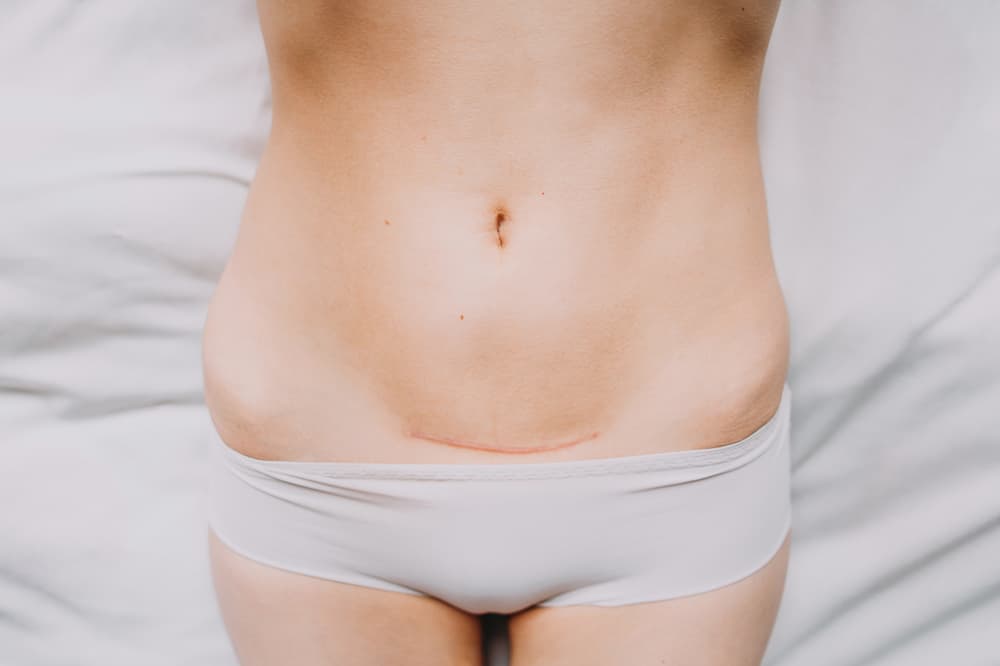
How Do I Know if My C-Section Has Opened Inside?

Your internal stitches start dissolving a few days after your c-section. But that incision stays fragile for about six weeks and may not fully heal for three months (Mayo Clinic).
It can be unnerving to heal a wound you can't see. So if you're lying on the couch wondering, "How do I know if my c-section has opened inside?", you are not alone, mama.
The good news is that internal dehiscence is rare: it happens in about 0.6% of cesarean deliveries (NCBI/PMC). But because a true rupture is a genuine emergency, it's worth knowing the warning signs by heart.
Here's the golden rule to keep in your back pocket:
You should feel a little better and bleed a little less every day after your c-section. If you start to feel worse, call your doctor right away.
How can you tell if your c-section has opened inside?
Internal c-section dehiscence shows up through your body, not your incision, because the opening is hidden under healthy skin. Heavy bleeding, fresh red blood after brown lochia, foul odor, clots larger than a plum, fever over 100.4°F, or sudden severe pain are the main red flags (Mayo Clinic).
Monitoring stitches you can't see is scary, we know. But your body is a good narrator. Here's the full list of signals worth paying attention to.
Heavy vaginal bleeding after the first 24 hours
Some bleeding (called lochia) is normal for 4 to 6 weeks postpartum, and it should taper. Call your doctor if you soak through one pad an hour for two hours in a row, or if the flow increases instead of slowing down (ACOG).
Fresh bright-red blood after it had turned brown
Lochia usually shifts from bright red to pink or brown by the end of the first week. A sudden return to fresh red blood can mean new bleeding (Mayo Clinic).
Our guide to bleeding after a c-section that stopped and started again walks through when this is normal and when it isn't.
Offensive-smelling lochia
Normal lochia has a faint, metallic smell. If the odor turns foul or fishy, it can point to infection, which is a common companion to an open incision. Mayo Clinic flags foul-smelling discharge as an urgent symptom after cesarean (Mayo Clinic).
Passing large blood clots
Small clots are normal for the first 1 to 3 days. Report any clot larger than a plum (or a golf ball) or any clots that show up more than three days after delivery.
Severe abdominal pain
Your incisional pain should ease a bit every day, often with the help of ibuprofen or acetaminophen as advised by your provider (Mayo Clinic). Call right away if pain spikes, becomes sharp, or stops responding to your usual relief.
Our guide to pain after a c-section covers what's normal week by week.
Fever of 100.4°F or higher
A postpartum fever of 100.4°F (38°C) or higher is a medical emergency until proven otherwise, because it's the classic sign of postpartum infection (ACOG).
Dizziness, faintness, or shortness of breath
Internal bleeding can drop your blood pressure, and you may feel lightheaded, clammy, or unable to catch your breath. These symptoms need emergency care, not a next-day appointment.
New bruising on your belly (away from the incision)
Bruising that spreads across your abdomen, especially if it wasn't there yesterday, can point to internal bleeding under the skin.
Painful urination or painful bowel movements
Burning pee can signal a urinary tract infection, and sharper or prolonged pain with bowel movements can reflect irritation from a deeper wound problem. If bowel pain lasts beyond the first week or gets worse, flag it. Our guide to pooping after a c-section covers what should feel normal.
What can cause a c-section to open inside?
The medical term is postpartum uterine wound dehiscence, and it affects about 0.6% of cesarean deliveries (NCBI/PMC). Most cases trace back to doing too much too soon or to an underlying infection that weakens the healing tissue.
Known risk factors include:
- Exercising or lifting more than your baby's weight in the first 6 weeks
- Sex before 4 to 6 weeks postpartum (ACOG)
- Infection at the incision or in the uterus
- Obesity, diabetes, or smoking, which slow wound healing
- Poor suturing or wound tension
- Chronic cough or severe constipation that strains the abdomen
If any of these sound familiar, don't panic. It just means you want to be a little extra vigilant about rest and red flags.
What happens if your c-section opens inside?
If you suspect internal dehiscence, call your OB or labor-and-delivery line today, or go to the ER if you're bleeding heavily, feverish, or faint. This is a potentially life-threatening complication, and waiting to "see how it goes" is not the move here.
Treatment depends on how much the wound has opened (NIH/PMC):
- Small opening: Your doctor may prescribe antibiotics and place a drain to help excess fluid escape while the wound closes on its own. Extra pain medication is common.
- Mid-sized opening: You'll likely need a return trip to the OR. The surgeon removes dead tissue and re-stitches the layers. Recovery adds a few weeks.
- Complete uterine rupture: This is rare and usually shows up during labor after a prior cesarean, not at home afterward. It may require emergency repair or, in severe cases, a hysterectomy.
Early attention usually means simpler treatment. That's why the "call your doctor if you feel worse" rule is so important.
Signs of internal infection after a c-section often show up alongside dehiscence, so it's worth reading both lists together.
How can you avoid rupturing your internal stitches?
The biggest protective factors are rest and patience. Mayo Clinic recommends not lifting anything heavier than about 10 to 15 pounds for the first couple of weeks, and resting when the baby sleeps (Mayo Clinic). Most providers extend the lifting and exercise restriction to the full six weeks.
Here's the practical checklist:
- Rest whenever you can, even if it's just on the couch with the baby.
- Don't lift anything heavier than your baby for the first 6 weeks.
- Eat well: lean protein, fruit, vegetables, and plenty of fiber.
- Drink lots of water to ease constipation and straining.
- Avoid strenuous exercise until your provider clears you. Our guide to c-section recovery exercises covers gentle starter moves.
- Delay sex after a c-section until 4 to 6 weeks postpartum.
- Take a stool softener or gentle laxative if constipation flares up.
- Avoid deep bending after a c-section until you're cleared.
- Support the incision with a pillow when you cough, laugh, or sneeze.
And be kind to yourself while you're healing, mama. A c-section is major abdominal surgery, and "just resting" counts as recovery work.
When should you call your doctor or 911?
Call your doctor immediately if you notice any of the warning signs above, especially a fever over 100.4°F, heavy bleeding, fresh red blood, large clots, foul-smelling lochia, or severe new pain (Mayo Clinic). Postpartum infection and dehiscence move fast, and early treatment makes a real difference.
Dial 911 (or your local emergency number) if you are:
- Bleeding so heavily you can't change pads fast enough
- Passing multiple large clots in a row
- Feeling faint, confused, or struggling to breathe
- Seeing a hard, spreading bruise on your abdomen
Better to arrive at the ER and be told everything is fine than to talk yourself out of the call. It's one of those "better to ask" moments.
Final thoughts
Tearing your internal stitches is rare, happening in just 0.6% of cesarean births (NCBI/PMC). So if you've overdone it a little, take a breath, rest, and keep an eye on your temperature, pain, and bleeding.
The single thing to remember: you should feel a tiny bit better every day. If today is worse than yesterday, that's your cue to call your provider. Trust what your body is telling you, mama. You know more than you think.
This article is for informational purposes only and is not a substitute for professional medical advice. If you're worried about any symptom after your c-section, call your healthcare provider, obstetrician, or midwife, or go to your nearest emergency department.