Best Diapers for Babies to buy in 2026 (and which ones to avoid!)

Picking the right diaper is one of those new-parent decisions that feels much bigger than it should. You walk into the store, see forty brands stacked to the ceiling, and the packaging tells you almost nothing useful. We know, mama. We've stood in that same aisle.
The good news: you won't get it perfect on the first try, and that's fine. Newborns need 10 or more diaper changes a day (HealthyChildren.org / AAP), so you'll have plenty of feedback fast. The goal isn't to pick the "best" diaper in the abstract. It's to find the one that fits your baby without leaking, chafing, or bankrupting you.
Below are our top picks across disposables, cloth, and swim, plus the buyer's guide we wish we'd had in the early days.
What are the top disposable diapers for 2026?
Most American babies wear disposables for at least part of their first years, and they average roughly 2,500 to 3,000 diapers in year one alone (HealthyChildren.org / AAP). The right disposable keeps your baby dry between changes, sits softly against delicate skin, and doesn't leak at 3 a.m. when everyone is running on fumes.
Not every parent weighs those features the same way. Some want the greenest option. Others want a workhorse at a reasonable price. We've tried to cover both camps in our top 5.
Quick Comparison
| Rank | Name | Rating | Where to Buy |
|---|---|---|---|
| 1 | Nature Babycare | Amazon | |
| 2 | Babyganic | Amazon | |
| 3 | Bambo Nature | Amazon | |
| 4 | Seventh Generation | Amazon | |
| 5 | Babies R Us | Amazon |
Nature Babycare
A fantastic diaper, and the most absorbent disposable we've tested. It's also the greenest one on the market, so if keeping a small footprint matters to you, this is where we'd start.
We love that it can be both things at once. The brand is also working on greener packaging, and the leakage numbers are genuinely excellent.
There's a trade-off, though. It doesn't fit quite as snugly as some others, and durability runs a little lower than average. We think the exchange is fair when you're getting this level of absorbency and eco-friendliness, but your baby might feel differently.
Absorption: Top of the class. Your little one stays drier for longer, which helps head off diaper rash.
Leakage: Respectable, not the best. The speed of absorption pulls liquid to the core fast.
Fitting & Comfort: Not its strongest area. The eco-friendly materials fit a little looser, which can cause the odd leak.
Durability: On the lower side, so expect more frequent changes. That's the cost of biodegradable materials.
Babyganic
The best all-rounder on our list. Pick this one if green isn't your top priority and you just want a comfortable, absorbent diaper that performs in every category.
The eco rating is only "fair," since Babyganic hasn't gone biodegradable. They have chosen to be chlorine-free and latex-free, which matters for sensitive skin. Unlucky not to make the top spot for us.
Absorption: Right up there with the best. Only Nature Babycare beat it, and the margin was tiny.
Leakage: Middle of the pack in our tests. Online reviews flag the odd leak, usually a fit issue.
Fitting & Comfort: Among the best tested. Soft inner lining and strong elastic.
Durability: Strong. Babyganic prioritized comfort and durability over biodegradability.
Buy at AmazonVisit Babyganics.com
Bambo Nature
The second-most ecological pick on our list, and our favorite "balance" diaper. It scores above average in every test we ran, which in diaper-land is actually exciting.
We like that it doesn't force the choice between green and comfortable. Bamboo is used in the inner lining, which feels wonderfully soft against baby skin.
Absorption: Above average. Not quite top-tier, but entirely satisfactory for avoiding rash-causing moisture.
Leakage: Middle of the pack, with mixed online reviews. Fit plays a big role here.
Fitting & Comfort: Second-best on this list. The bamboo lining is the star.
Durability: Above average. Diapers have short lifespans anyway.
Buy at AmazonVisit Bambonature.com
Seventh Generation
This one is both magnificent and a little flawed. It's one of the best diapers we've tested for health and ecological impact, with strong durability and well-above-average absorption.
It misses the podium because leakage and comfort run below average, and those two things often feed each other. If green and durable top your list, you'll still love it.
Absorption: One of the best on the market. This is why it made our top 5 despite the mixed results elsewhere.
Leakage: A touch below average, and it's the main reason it lands at #4.
Fitting & Comfort: Mixed. The material isn't the softest, though the elastic does help fit.
Durability: Excellent, second-best on this list. The firmer materials drive both strengths and weaknesses.
Buy at AmazonVisit Seventhgeneration.com
Babies R Us
The budget pick. It isn't worried about being green or especially gentle, but it absorbs well, leaks less than expected, and costs meaningfully less.
If you're on a tight budget, test it on your baby for fit and skin reaction. Some babies sail through; others need something gentler.
Absorption: Above average, which is impressive at this price point.
Leakage: Top 10% in our testing, and spectacular when you factor in the cost.
Fitting & Comfort: More than satisfactory. Not a standout, but solid for the price.
Durability: Built to do the basics well on a budget. Not focused on eco.
Buy at AmazonVisit BabiesRUs.ca
Which cloth diapers are worth your money?
Cloth is the most ecologically friendly option overall, though the gap narrows once you factor in hot washing and energy use. The American Academy of Pediatrics treats cloth and disposables as equally acceptable from a health standpoint, so the choice mostly comes down to your values, laundry tolerance, and schedule (HealthyChildren.org / AAP).
They look adorable, too. In warm months, many families let baby wander around in just a cute cloth diaper to keep cool. Any of these five would serve your baby well. Pick the one that matches your budget and laundry rhythm.
Quick Comparison
| Rank | Name | Rating | Where to Buy |
|---|---|---|---|
| 1 | Rumparooz G2 | Amazon | |
| 2 | Flip Hybrid | Amazon | |
| 3 | GroVia Hybrid | Amazon | |
| 4 | Blueberry One Size | Amazon | |
| 5 | bumGenious Freetime | Amazon |
Rumparooz G2
Our top cloth pick. It scored best overall on absorption, durability, and comfort, and the name alone would win it plenty of friends.
It fits particularly well and is seriously absorbent. The double gusset keeps messy stool away from the edges, which matters more than you'd think once you've cleaned up a cloth-diaper blowout.
You can use it stand-alone or layered for extra security, which makes it flexible through growth spurts and overnight stretches.
Buy at AmazonVisit Kangacare.com
Flip Hybrid
An excellent diaper with a pricing edge. It scores second overall for absorption and comfort, and when well-fitted, leaks are rare.
The icing on the cake is the price: roughly 25% cheaper than our top pick. That's a real difference when you're stocking a cloth rotation.
Buy at AmazonVisit Flipdiapers.com
GroVia Hybrid
Probably the greenest cloth diaper we've tested, which matters a lot to our eco-focused readers. It also performs well above average on absorption and comfort.
It uses an outer shell with three inner-insert options, so you can match the absorbency to the situation. Daytime runabout, overnight sleep stretch, nap time, each one gets a different insert.
Blueberry One Size
This one is gaining a loyal following fast. It's not cheap (roughly double the Flip Hybrid), but the quality shows.
Outer waterproof layer, 100% cotton inner, careful stitching. If you want one really nice cloth diaper in your rotation, this is the one to splurge on.
Buy at AmazonVisit Blueberrydiapers.com
bumGenious Freetime
The closest cloth diaper to a disposable in feel and ease of use. Our favorite all-in-one by a wide margin, and popular with parents new to cloth.
Comfort and convenience are the wins here. Absorption runs a touch behind double-layer cloth options, which is the price you pay for simplicity.
Buy at AmazonVisit Bumgenius.com
Which swim diapers actually work in the pool?
Standard diapers rely on Super Absorbent Polymer (SAP) to trap liquid, and SAP stops working underwater. Swim diapers have a completely different job: containing stool, not liquid. That's why most pools have a strict swim-diaper rule, and why the CDC asks families to change swim diapers in the bathroom, not at poolside, to prevent waterborne illness (CDC).
For swim, cloth wins over disposable. Disposables sag quickly when wet, and a loaded disposable in water is a disaster. Cloth holds everything in even when heavy, and your baby stays comfortable. Here are our top 5 reusable swim picks.
Quick Comparison
| Rank | Name | Rating | Where to Buy |
|---|---|---|---|
| 1 | i.play | Amazon | |
| 2 | Finis Swim Diapers | Amazon | |
| 3 | Alva Swim Diapers | Amazon | |
| 4 | AppleCheeks Swim Diapers | Amazon | |
| 5 | Kushies Swim Diapers | Amazon |
i.play
The oldest and most popular swim diaper on the market. We love the side-snap version because changing a wet, dirty swim diaper is a messy affair, and side access saves your sanity.
Treat them well, follow the wash instructions, and air dry them. They'll carry you through a full summer.
Buy at AmazonVisit Greensproutsbaby.com
Finis Swim Diapers
We like the boy-specific and girl-specific cuts. These can hold a little fluid, though don't treat them like a day diaper.
Comfort is strong when sized right. The negatives: not machine washable, and they're pull-up style, so they sag a bit when stool arrives.
Buy at AmazonVisit Finisswim.com
Alva Swim Diapers
The new kid on the block, and a genuinely one-size-fits-all design. A side snap makes fitting easy, and they are machine washable and dryable.
Practical and growing in popularity, fast.
Buy at AmazonVisit Alvababy.com
AppleCheeks Swim Diapers
A bit of a cult favorite. Those who know them, love them. The snap system adjusts for a precise fit and makes removal simple.
The standout detail? Genuinely hard to find a bad review online.
Buy at AmazonVisit Greendiaperstore.com
Kushies Swim Diapers
Our budget swim pick. Quality runs below our top 4, but it still does the job for casual pool days.
It uses velcro and ties for a snug fit, and the construction is solid. Don't expect more than one season, but by next summer your little one will have grown anyway.
Buy at AmazonVisit Kushiesonline.com
How should you shop for diapers (without losing your mind)?
Start small, test for fit, and only buy in bulk once you know a brand works for your baby. New parents get pulled into subscription discounts before they've confirmed fit, and it's a rookie trap we'd love to save you from. A week of leaks and blowouts is all the feedback you need.
A few tips before you start
You already have your own diaper expectations. Cost, health, environment, fit, or all of the above. That's completely normal.
Don't buy in bulk until your baby has worn a brand for at least a week. Diaper companies know parents are creatures of habit, so they load up the bulk discounts to lock you in. Resist.
Wait until your baby is born before buying newborn sizes. Birth weights vary. A large baby can skip newborn sizes entirely. Our guide on how long newborn clothes fit covers the same "bigger than expected at birth" surprise.
For European brands, check the sizing. They often use kilograms and their own weight brackets.
How is a diaper actually built?
Most diapers have three layers.
The inner layer sits against your baby's skin. It's soft, and its job is to pull moisture away into the core so the skin stays dry.
The middle layer is the absorbent engine. It traps moisture away from the skin, which is the biggest factor in preventing diaper rash.
The outer layer is a waterproof shell that stops leaks reaching clothing.
Why absorbency matters more than anything else
Absorbency is the single biggest factor in diaper performance, and it's not just about total capacity. It's also about how well the diaper keeps moisture away from skin between changes.
A poorly absorbent diaper leaves skin persistently damp, which is the fastest route to diaper rash. If your baby does develop a rash, our guide on how to treat and prevent diaper rash walks through everything from zinc oxide cream to when to call your pediatrician.
What is SAP, and is it safe?
The little gel-like beads you sometimes see in diapers are Super Absorbent Polymer, or SAP. This technology is what makes modern disposables work: it can absorb many times its own weight in liquid, turning from crystals into a clear gel on contact with moisture.
If a few beads escape onto your baby's skin, wipe them off and carry on. SAP is considered non-toxic and has been used in diapers for decades. Even diapers marketed as "eco-friendly" proudly use it, because no plant-based alternative matches its performance.
How do you know a diaper fits properly?
Diapers are sized by weight, but brands cut differently. Think of them like clothing: same size label, different actual fit. For a diaper to do its job, the fit has to be right.
Two fingers should slide easily under the waistband, leg cuffs should sit out (not tucked in, which is the #1 cause of leaks), and there should be no red marks on belly or thighs when you take it off. Blowouts up the back usually mean the diaper is too small. Leaks around the legs usually mean the cuffs are tucked or the brand doesn't match your baby's body shape.
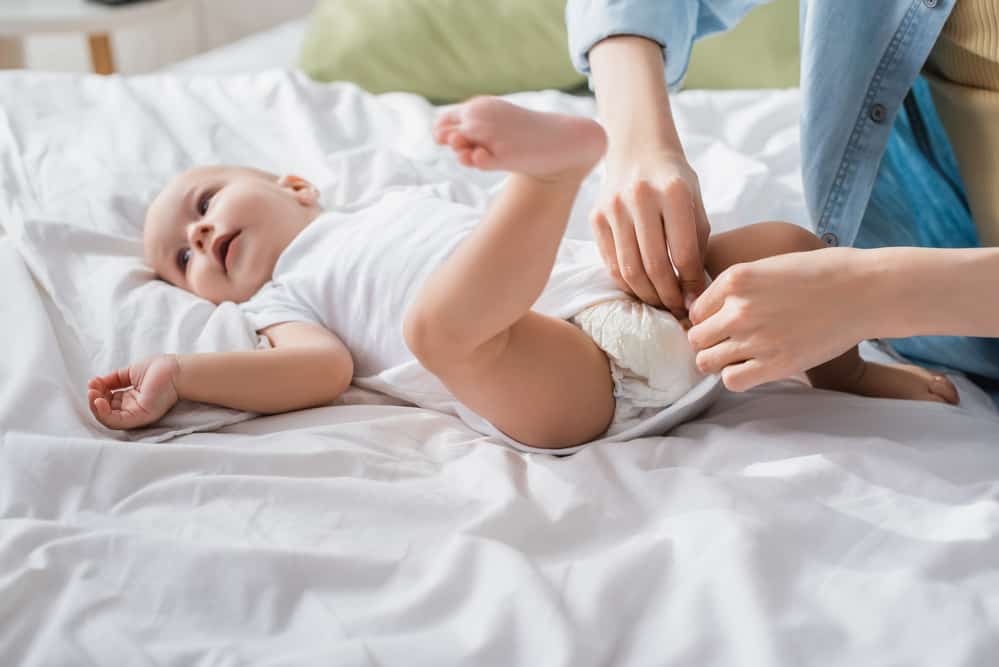
Our step-by-step guide on how to change a diaper covers the fit checks in the moment.
Comfort matters too
Soft skin picks up on small details. Tab materials, rounded corners, smooth seams: the little things add up across thousands of diaper hours.
Most mid-tier brands have the basics covered, so focus on the edges. Soft tabs, no stiff seams along the thighs, and fragrance-free lining all make a difference to a fussy baby.
Thinking green without the guilt
If the environment matters to you, the information can feel overwhelming. Biodegradable diapers are a start, though they need specific conditions (oxygen, light) to break down, which most landfills don't provide.
Cloth is the most eco-friendly option overall, but it uses water and energy for washing. Hybrid approaches (cloth at home, disposables for travel) are genuinely green without the all-or-nothing stress. Pick the setup you'll actually stick with.
Watch for "hypoallergenic" marketing
If your baby has sensitive skin or a latex allergy, look for latex-free and fragrance-free diapers. Just know that the word "hypoallergenic" isn't federally regulated for diapers, so it can mean different things from brand to brand.
When in doubt, patch-test a new brand for a day before buying a full case. The FDA's cosmetic-labeling note on "hypoallergenic" applies more broadly to baby products too (FDA).
Don't let price be the whole story
New parents often compare diaper prices using the newborn size, and brands know it. Newborn diapers are the cheapest size because babies grow out of them in weeks, and the real money arrives with size 3 and up.
A better approach: test a small pack first, check the fit and your baby's skin, then look at subscriptions for the brand that genuinely works. Subscription discounts are real, but they're only a win if the diaper fits.
How many diapers do babies go through, anyway?
Newborns need 10 or more diaper changes a day, which drops to 6 or 8 by toddler age (HealthyChildren.org / AAP). Over the first year, that adds up to roughly 2,500 to 3,000 diapers. Yes, really.
If you're pregnant and budgeting, plan for a bigger diaper line item than you expect, especially for the first six months. A lot of families balance the cost by asking for diaper subscriptions or bulk packs instead of tiny outfits at the baby shower. (Our guide on push present ideas has gift alternatives for the mom, if partners or relatives are still asking.)
Once your baby can stand, a whole new product category opens up. For the diapers-to-pull-ups transition, see our notes on when to switch from diapers to pull-ups. And if overnight leaks are the issue, how long you can leave a diaper on overnight covers the trade-offs.
Frequently asked questions about diapers
How many diapers will my baby actually go through?
Newborns need 10 or more diaper changes a day, which works out to every 2 to 3 hours (HealthyChildren.org / AAP). By toddler age, that drops to 6 or 8 changes. Over the first year, most babies go through roughly 2,500 to 3,000 diapers. Buy small packs first, and stock up only once you've confirmed the brand fits your baby.
Are cloth diapers really better for the environment?
Cloth diapers typically have a smaller overall footprint than disposables, but the gap narrows once you factor in washing water and energy. The AAP treats both cloth and disposable as acceptable from a health standpoint (HealthyChildren.org / AAP). The greenest setup is line-drying, cold washes, and reusing across siblings. Many families mix both without guilt.
Is SAP (the gel inside diapers) safe if my baby touches it?
Yes. Super Absorbent Polymer is non-toxic and has been used safely in disposable diapers for decades. It turns into a clear gel on contact with moisture. If a few beads escape onto your baby's skin, wipe them off and carry on. Call your pediatrician only if you see skin irritation or have swallowing concerns.
How do I tell if a diaper fits properly?
Two fingers should slide easily under the waistband, the leg cuffs should sit out (not tucked in), and there should be no red marks on thighs or belly when you remove it. If you're seeing blowouts up the back, size up. If you're seeing leaks around the legs, check the cuffs or try a different brand.
When do I switch from diapers to pull-ups?
Most families switch between ages 2 and 3 for potty training, once the child can stand independently and pull them up. Modern pull-ups match diaper absorbency, so the decision is about mobility and readiness, not capacity. Our full walkthrough on when to switch from diapers to pull-ups covers the timing signs.
The bottom line
Choosing a diaper feels like a much bigger decision than it actually is, and that's okay. The truth is, most modern diapers do their core job well. The real variable is fit, and you won't know for certain until your baby has worn the brand for a few days.
Start with one of our top 5 picks that matches what you care about most (eco, budget, or all-rounder). Buy a small pack, not a case. If your baby stays dry, has no leaks, and doesn't develop redness, you've found your brand.
And if not? Try the next one. That's all this is. A bit of testing, a bit of learning your baby's shape, and a lot of diaper changes. You've got this, mama.
This article is for informational purposes only and is not a substitute for professional medical advice. Always consult your pediatrician for guidance specific to your baby, especially for skin reactions or persistent diaper rash.